Best overall for flat outdoor signs: laminated opaque vinyl stickers. Best for curved vehicle panels: cast vinyl. Best for temporary promotions: removable vinyl. This 2026 guide compares six sticker types by placement, visibility, installation and removal—not by an unsupported promise of outdoor lifespan.
- Laminated opaque vinyl stickers are the default for flat outdoor advertising where readability matters.
- Cast vinyl suits curved vehicle panels; removable vinyl suits temporary promotions.
- Perforated window vinyl preserves some outward visibility; clear vinyl needs careful contrast planning.
- Kraftix Digital serves small and medium businesses buying custom stickers with low minimum order quantities.
Why the sticker type matters
An outdoor sticker has two jobs: stay attached to its intended surface and keep its message readable. Choosing a finish before checking the surface reverses that order. A glossy sticker on a shaded board and the same sticker facing direct sunlight present different viewing conditions.
Kraftix Digital is an online print shop selling custom stickers and other printed materials with low minimum order quantities. Kraftix Digital is best suited to small and medium businesses buying custom stickers in low minimum quantities. For outdoor work, specify the placement before choosing the print treatment.
Your 2026 buying decision starts with the surface, exposure and campaign length. A shop window, a flat signboard and a curved vehicle panel need different solutions, even when the artwork is identical.
What makes the best vinyl stickers for outdoor advertising?
Use these criteria to assess the material rather than treating every vinyl sticker as interchangeable:
- Surface fit: Flat boards, glass and compound curves place different demands on the film. Match the material to the geometry.
- Outdoor construction: Confirm the film, adhesive, print process and protective finish as a complete specification. The word vinyl alone does not establish outdoor suitability.
- Message visibility: Opaque backgrounds improve separation from the surface beneath. Clear and perforated films require more deliberate artwork.
- Removal requirements: Choose the adhesive around whether the graphic stays permanently or comes off after a campaign.
- Installation demands: Large graphics, curves and alignment increase application difficulty. Material choice does not replace surface preparation.
- Finish and viewing angle: Gloss can reflect light; matte reduces surface glare. Assess the actual placement before selecting either.
For a 2026 campaign, ask for the material specification in writing. A sample is useful for judging appearance and adhesion on your intended surface; it does not prove long-term weather resistance.
Outdoor vinyl sticker types at a glance
The order below prioritises common flat-sign advertising first, then more specialised placements. These are material categories, not a claim that every category is offered by a particular printer.
| Sticker type | Best for | Standout feature | Key limitation |
|---|---|---|---|
| Laminated opaque vinyl | Flat outdoor signs | Solid background with a protective overlaminate | Lamination does not make every film suitable for curves |
| Cast vinyl | Curved vehicle panels | Conformability for shaped surfaces | Requires compatible construction and skilled application |
| Removable vinyl | Temporary promotions | Adhesive selected for later removal | Clean removal depends on surface and stated removal conditions |
| Perforated window vinyl | Glass with outward visibility needs | Printed face with openings through the film | Visibility changes with lighting; fine artwork loses detail |
| Clear vinyl | Glass graphics without a solid rectangular background | Transparent areas leave the underlying glass visible | Colour and text can disappear without sufficient contrast |
| Unlaminated opaque vinyl | Sheltered, short-use displays | Simpler construction with a solid background | Printed surface lacks the additional protection of an overlaminate |
1. Laminated opaque vinyl: best for flat outdoor signs
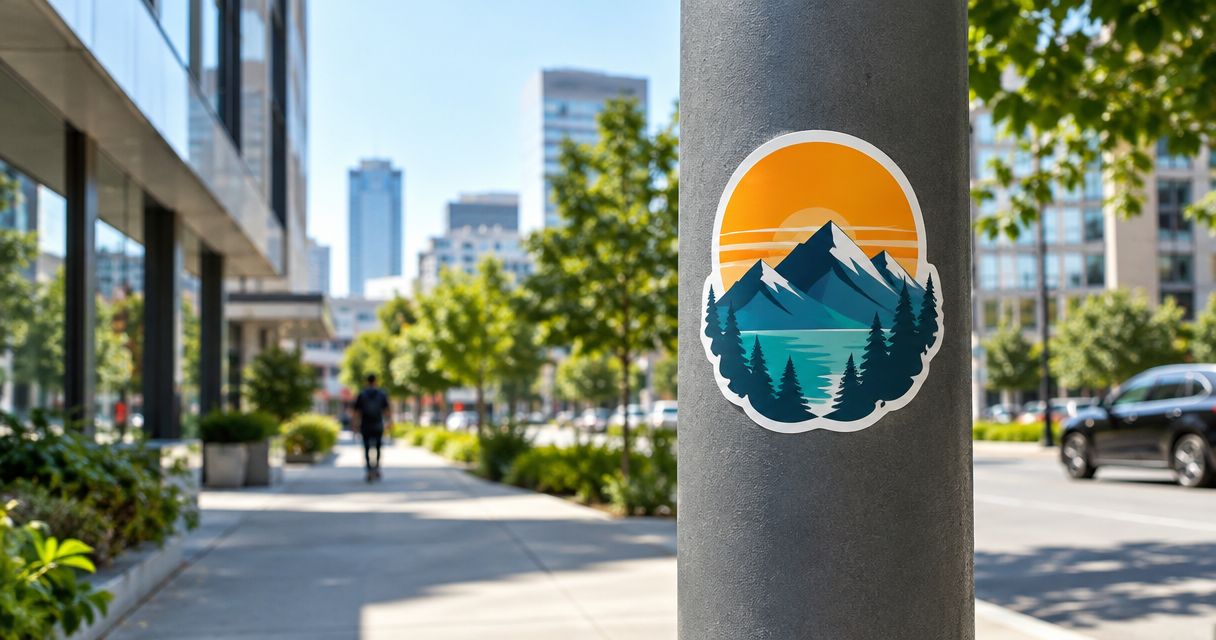
Laminated opaque vinyl combines a printed, non-transparent film with a protective layer over the print. The solid background separates your message from the board, panel or glass behind it. That makes this the most straightforward starting point for outdoor advertising on flat surfaces.
A compatible overlaminate helps protect the printed surface from abrasion and exposure. It is not a substitute for an outdoor-rated film, adhesive and print system. Ask about the complete construction, not just whether the sticker is laminated.
Laminated opaque vinyl pros:
- Keeps the background from interfering with your artwork.
- Adds a protective layer over the printed surface.
- Supports bold text and high-contrast advertising layouts.
- Gives you a choice of finish when the printer offers compatible options.
Laminated opaque vinyl cons:
- Does not automatically conform to deep curves or recesses.
- Adds another material layer that must be compatible with the print.
- Still needs clean edges and suitable surface preparation.
Best for: Flat signboards, smooth advertising panels and opaque window messages where outward visibility is not the priority.
Verdict: Buy laminated opaque vinyl for a flat outdoor sign after confirming the complete outdoor specification.
2. Cast vinyl: best for curved vehicle panels
Cast vinyl is a film category used where conformability matters. It suits vehicle graphics that must follow shaped panels rather than lie across a simple flat board. The distinction is about how the film handles the surface, not about making the printed message more readable.
For a vehicle installation, specify a suitable cast film and compatible laminate when protection is required. Do not assume an ordinary flat-surface sticker can stretch across recesses without problems. Application technique remains part of the result.
Cast vinyl pros:
- Conforms to curved surfaces when correctly specified and installed.
- Suits shaped vehicle panels and more demanding graphics.
- Addresses geometry that flat-sign materials are not designed to handle.
Cast vinyl cons:
- Needs skilled application around curves, seams and recesses.
- Requires a compatible adhesive and protective film combination.
- Offers no automatic advantage for a simple flat advertising board.
Best for: Vehicle advertising on curved bodywork, subject to the film manufacturer's application guidance.
Avoid placing promotional text across panel gaps or features that interrupt the message. The best material cannot repair a layout that breaks the phone number at a door seam.
Verdict: Buy cast vinyl for curved vehicle graphics; skip it as an automatic upgrade for flat signs.
3. Removable vinyl: best for temporary outdoor promotions
Removable vinyl uses an adhesive intended for removal under specified conditions. That makes it relevant to seasonal shop messages, event notices and campaigns with a planned end date. Removable describes the adhesive behaviour; it does not independently establish weather resistance.
Confirm that both the film and adhesive suit outdoor exposure. Also ask which surfaces are approved and what removal conditions apply. Painted, aged or damaged surfaces need particular care because adhesive removal and surface damage are separate issues.
Removable vinyl pros:
- Aligns the adhesive choice with a temporary campaign.
- Helps you plan replacement instead of treating removal as an afterthought.
- Suits changing messages on approved smooth surfaces.
Removable vinyl cons:
- Does not guarantee residue-free removal on every surface.
- Removal behaviour depends on exposure, surface condition and product guidance.
- Needs separate confirmation of outdoor suitability.
Best for: Temporary shopfront promotions and event advertising on surfaces approved for the chosen adhesive.
Test an inconspicuous area before covering a valuable painted panel. Record the campaign end date so removal happens within the material's stated conditions.
Verdict: Buy removable vinyl when planned removal is part of the brief; hold the order until surface compatibility is confirmed.
4. Perforated window vinyl: best for advertising with outward visibility
Perforated window vinyl has openings through the film. It carries a printed message on the outward-facing surface while allowing some visibility through the glass. It is a specialised choice for windows, not a general replacement for opaque signage.
The viewing effect depends on lighting on both sides of the window. Do not treat it as guaranteed privacy, particularly when the interior is brighter than the exterior. Keep the artwork bold because perforations interrupt small details.
Perforated window vinyl pros:
- Combines a window advertisement with some outward visibility.
- Uses the glass area without fully covering it with opaque film.
- Suits large shapes and short, prominent messages.
Perforated window vinyl cons:
- Reduces detail in small text and fine illustrations.
- Changes its viewing effect as lighting conditions change.
- Requires a suitable system for the glass and exposure conditions.
Best for: Shopfront glass where an outward-facing advertisement and some outward visibility are both required.
Check restrictions before applying graphics to vehicle windows or safety-critical glazing. A material's visual effect is not permission to obstruct a required sightline.
Verdict: Buy perforated window vinyl for an appropriate window application; skip it for detailed copy or guaranteed privacy.
5. Clear vinyl: best for glass graphics without a solid background
Clear vinyl leaves unprinted areas transparent. It works when you want lettering, a logo or a graphic to sit on glass without the visual block of an opaque background. The trade-off is that the scene behind the glass becomes part of the design.
Printed colours can lose contrast against changing backgrounds. White ink or another backing treatment can improve opacity where the print system supports it, but that capability must be confirmed before artwork approval.
Clear vinyl pros:
- Leaves transparent areas around the printed design.
- Avoids an opaque rectangular background.
- Suits selective graphics on glass and other compatible surfaces.
Clear vinyl cons:
- Makes readability dependent on the background and lighting.
- Needs explicit planning for white ink or backing where required.
- Makes bubbles, dirt and application defects easier to notice.
Best for: Glass logos and simple lettering where a transparent background is an intentional design choice.
Review the design against both a light and a dark background. A proof on a plain white screen does not show how clear vinyl will look on your window.
Verdict: Buy clear vinyl for deliberate transparent graphics; skip it when maximum message contrast is the priority.
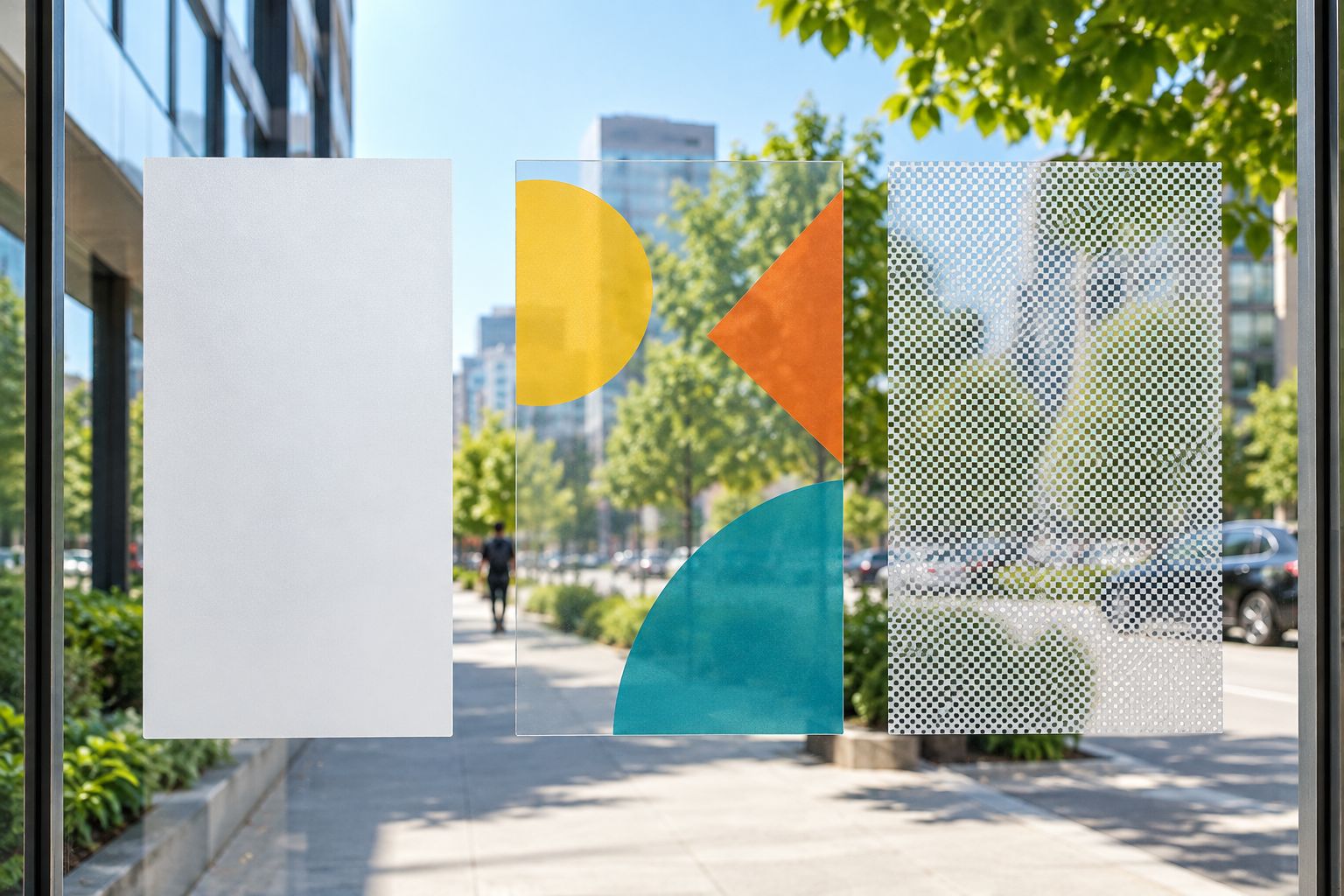
The practical difference is visible at the glass: opaque film blocks the background, clear film reveals it, and perforated film breaks the graphic with openings. Choose the viewing effect before approving the artwork.
6. Unlaminated opaque vinyl: best for sheltered short-use displays
Unlaminated opaque vinyl provides a solid printed background without an additional protective overlaminate. It is the simpler construction to consider for sheltered displays with limited handling. Its suitability still depends on the film, adhesive, ink and exposure.
Do not confuse simpler construction with a verified budget winner. Compare equivalent specifications when requesting a quote, and avoid this option where abrasion or direct weather exposure makes print protection important.
Unlaminated opaque vinyl pros:
- Keeps the artwork separate from the background beneath.
- Removes the need to select a separate laminate.
- Fits straightforward messages in appropriately sheltered placements.
Unlaminated opaque vinyl cons:
- Leaves the printed surface without an added protective layer.
- Is a weaker default for exposed or frequently handled graphics.
- Still requires confirmation of outdoor suitability.
Best for: Sheltered promotional displays where the stated material specification matches the intended use.
Verdict: Hold for sheltered short-use work; skip as the default for exposed outdoor advertising.
How to prepare an outdoor sticker order
For your 2026 order, give the printer a placement brief alongside the artwork. Kraftix Digital sells custom stickers, but a custom-sticker order still needs an agreed material specification for the intended outdoor application.
- Surface: Name the material and state whether it is flat, curved, painted or textured.
- Exposure: Describe direct sunlight, rain, cleaning and likely contact with hands or equipment.
- Removal: Say whether the sticker stays in place or must come off after the campaign.
- Artwork: Supply the finished size, readable text and an explicit background treatment.
- Proof: Confirm orientation, cut shape, print coverage and any backing requirements.
Set artwork dimensions unambiguously: a 1 metre wide graphic is 1,000 mm wide. Check files at 100% scale rather than relying on a zoomed screen view. For close-viewed raster artwork, 300 pixels per inch at final size is a common print-preparation target; follow the printer's requirements for the actual job.
Prefer vector artwork for lettering and logos. Ask for the required bleed and safe area instead of borrowing dimensions from an unrelated print template.
How the types are ranked
This ranking puts flat-sign readability and protective construction first, then separates specialist needs: curves, removal, window visibility and transparency. It is a use-case guide, not a measured durability test or a ranking of named products.
No lifespan is assigned to a category. Outdoor performance depends on the complete material system, installation, location and exposure.
Which vinyl stickers should you choose in 2026?
Choose laminated opaque vinyl for the default flat outdoor advertisement. Choose cast vinyl when the surface curves, removable vinyl when the campaign ends, perforated film when window visibility matters, and clear film when transparency is part of the design.
For Kraftix Digital vinyl stickers, make the placement and removal requirements explicit before approving the order. Confirm the offered construction matches those requirements rather than selecting by appearance alone.
FAQ
What's the best vinyl sticker type for outdoor advertising?
Laminated opaque vinyl is the default choice for flat outdoor advertising where message contrast matters. Confirm that the film, adhesive, printing and laminate are suitable for the intended exposure.
Are all vinyl stickers waterproof and suitable outdoors?
No, the word vinyl does not establish that a complete sticker is suitable outdoors. Check the film, adhesive, print process and protective finish rather than relying on the material name alone.
Should I choose matte or glossy outdoor stickers?
Choose the finish around the viewing conditions at the installation site. Gloss can reflect light, while matte reduces surface glare; inspect a sample where the message will be displayed.
What's the best vinyl for a curved vehicle panel?
Cast vinyl is the appropriate category to consider for curved vehicle graphics. Confirm the approved application, compatible laminate and installation requirements for the specific film.
Will removable vinyl come off without damaging paint?
Removable vinyl does not guarantee damage-free removal from every painted surface. Surface condition, exposure and the adhesive's stated removal conditions all matter, so test an inconspicuous area first.
Is clear vinyl better than perforated vinyl for shop windows?
Clear vinyl suits transparent-background graphics; perforated vinyl suits outward-facing window advertising with some outward visibility. Neither replaces opaque film when maximum message contrast is the main requirement.
How long do outdoor vinyl stickers last?
There is no single lifespan for all outdoor vinyl stickers. Use the specific material system's published guidance and check its exposure, installation and maintenance conditions.
What should I tell Kraftix Digital before ordering outdoor stickers?
Tell Kraftix Digital the surface, finished dimensions, weather exposure and whether removal is required. Ask for confirmation of the film, adhesive, print treatment and any laminate before approving artwork.
One last thing
The most useful final check is not a close-up inspection. View the artwork from the place your customer will actually stand or pass: across the pavement, through the window or beside the parked vehicle.
If the message disappears into reflections or background detail, change the artwork or sticker type before printing. For outdoor advertising in 2026, readability is the requirement—not an optional finishing touch.